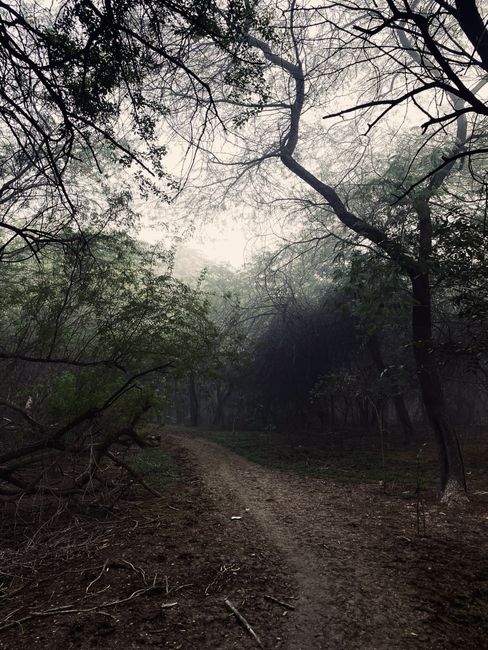
Introduction: Entering the Forest
Welcome, wanderers. The forest has been waiting. Over the past several months, the team at VOODOO NOOKS has been deep in the thickets of development, crafting every shadow and whisper that makes up Fallen Tree — a psychological horror narrative adventure that plunges players into a hostile woodland where memory and nightmare intertwine. Every rustle of leaves, every creak of a branch, carries the weight of untold stories. From initial concept to the builds you’re playing today, our journey has been one of both discovery and terror. In this sprawling dev log, we share three key moments from development and two update changelogs detailing the fixes and improvements that have shaped the experience. Whether you’re a longtime backer or new to the forest, we invite you to peer behind the curtain and see what goes into making horror that truly haunts.
Dev Log 1: The First Seed — Concept and Early Prototyping
Fallen Tree was born from a simple but haunting question: what if the forest itself could remember? In early brainstorming sessions, we were fascinated with folk horror and the concept of a natural world that is indifferent to humanity — or perhaps malevolent. We wanted a setting that felt alive and watchful, where every clearing could conceal a secret and every shadow might hold a threat. The forest had to be a character in its own right.
Our early prototype was scrappy but telling. Built over two months in Unreal Engine 5, it consisted of a small patch of procedurally generated woodland, a player character with basic interaction abilities, and a crude sanity system that reacted to proximity to certain objects — an abandoned campsite, a torn piece of clothing, a tree carved with cryptic symbols. The fog — our favourite early addition — was a dense, creeping presence that muffled sound and drastically reduced visibility. We found that players relied heavily on sound to navigate when sight was obscured; this became a core design pillar.
One of our most impactful decisions was to remove the mini-map entirely. Instead, players find hand-drawn map fragments in the world that reveal only part of the forest. These maps are incomplete by design, requiring players to pay attention to landmarks and their own mental map. It adds a layer of vulnerability and immersion that we quickly fell in love with.
The visual direction emerged from a blend of muted autumn colours and sickly greens. We wanted the world to feel beautiful but decaying, a place that had been left to rot. The colour palette — browns, greys, withered yellows — reinforces the themes of memory and loss. We also leaned into the use of negative space: empty clearings that feel too still, long corridors of identical trees that stretch into obscurity, and the occasional glimpse of something moving in the distance.
Significant early inspiration came from the phrase “Some things do not stay buried,” which we found scrawled inside the Abandoned Ranger Station. That line set the tone for everything: the narrative, the environmental design, the player’s feeling of unease. It appears in different forms throughout the game, a reminder that the forest does not forgive and does not forget.
Dev Log 2: The Living Wood — Technical and Design Challenges
Building the living wood of Fallen Tree was a delicate balancing act between scale and detail. The forest needed to feel vast and oppressive, but also hand-crafted where it mattered. We settled on a hybrid approach: a large terrain base with procedural tree placement, dynamic weather, and an evolving fog system, but with carefully authored points of interest — the Abandoned Ranger Station, the Sunken Chapel, the Whispering Grove — that contain puzzles, story beats, and environmental clues.
Resource management is at the heart of survival. Players must manage stamina, health, and a fragile state of mind. Running in the dark drains sanity quickly; staying in the light too long attracts unwanted attention. We spent weeks tuning these values to ensure the tension is constant but not overwhelming. The sanity system was particularly challenging: we wanted it to affect perception without breaking immersion entirely. In the final implementation, low sanity causes visual distortion — the trees seem to shift, whispers become more frequent, and the audio mix changes subtly to reflect a mind under duress.
The weather system adds another layer of unpredictability. Fog events reduce visibility dramatically, rain masks sound from enemies, and strong winds can obscure the audio cues that signal important discoveries. The weather is not random; it’s tied to in-game time and player actions, creating a rhythm that pushes players to seek shelter or press on at their own risk.
Audio design was a monumental undertaking. We recorded hundreds of hours of forest ambience — wind through branches, distant animal calls, the creak of decaying wood, the rustle of unseen animals — and layered them with unsettling tones that respond to the player’s state. The goal was to make players second-guess every sound: a branch snapping behind them might be a threat, or it could be the forest itself. The audio team also recorded custom vocals for the “whispering trees” effect, a sound that plays near certain locations and leaves players wondering if they heard something or imagined it.
Dev Log 3: Whispers from the Past — Crafting the Narrative
The narrative of Fallen Tree is deliberately fragmented, mirroring the memory of the protagonist, a former park ranger returning to the site of a tragedy that occurred years ago. Players piece together the story by exploring the forest, discovering notes, recording entries in their journal, and experiencing ‘echoes’ — visual and auditory flashbacks triggered by approaching certain locations.
Our writing team wove together multiple threads: the disappearance of a group of hikers, the legend of the “Fallen Tree” itself (a grove where the trees are said to whisper the names of the dead), and the protagonist’s own suppressed memories. The story is presented out of chronological order, and players must decide how deeply they want to dig. Some echoes are optional, and missing them can lead to a different understanding of events. We wanted players to feel complicit in uncovering the truth — or in choosing ignorance as a form of self-preservation.
Player decisions influence the ending, with three possible outcomes: The Forgotten (where the protagonist fails to confront the truth), The Remembered (where they uncover the full story but must live with it), and The Lost (a darker path that reveals a connection to the forest that goes beyond memory). Each ending is designed to feel earned and unsettling, and they all circle back to that core phrase: “Some things do not stay buried.”
One of my favourite memories from development was designing the Abandoned Ranger Station. That location became the emotional centre of the game. Every note found there reveals another layer of what happened — the ranger’s descent into obsession, his final entry, and the unanswered questions that still linger. The environmental storytelling there is dense: a chair pulled up to a radio, a map with circled locations, a photograph torn in half. Players who take the time to explore it fully will be rewarded with a deeper understanding of the world and its tragedy.
Update Changelog v1.1: The Patch of Whispers
This first update focused on stability and balancing based on early access feedback. The forest had become too quiet in some areas, and the sanity system was punishing in ways we didn’t intend.
Bug Fixes
- Fixed AI patrol paths that could cause enemies to become stuck on fallen logs and rocks.
- Resolved an issue where the sanity meter could continue draining in interiors with sufficient lighting.
- Addressed a rare crash that occurred when entering the Sunken Chapel from the eastern path.
- Corrected missing audio cues for certain ‘Echo’ triggers in Sector 3.
- Fixed a visual glitch where fog occlusion appeared incorrect near water bodies.
Tweaks
- Reduced sanity drain rate in the early game by 15% to give new players more breathing room.
- Increased visibility range during fog events from 8m to 12m, reducing frustration in navigation.
- Added three new campfire locations in Sector 3 to balance resource distribution.
- Updated the journal UI to better differentiate discovered notes from unexplored ones.
- Adjusted enemy detection cone to be more forgiving when the player is crouched.
Update Changelog v1.2: The Clearing Update
Our second major update introduced new content and refined existing mechanics, as well as addressing community requests.
New Features
- Added five new environmental puzzles in Sectors 4 and 6, involving wind chimes and pressure plates.
- Introduced collectible “Carved Stones” that reveal lore when examined near a campfire.
- New musical sting for major narrative reveals, composed specifically for the three ending sequences.
- Implemented a photo mode for players to capture their scariest moments.
Bug Fixes
- Fixed a progression blocker in the “Mossy Ridge” puzzle where a stone wouldn’t trigger after being examined.
- Corrected several dialogue options that failed to appear if the player missed specific notes earlier.
- Improved performance in the central forest clearing by optimising tree LODs and culling distant shadows.
- Fixed an issue where the “Whispering Trees” effect could persist after leaving the area.
- Resolved save game corruption that could occur when quitting during a fog event.
Balancing
- Increased stamina recovery rate when standing still by 20%.
- Slightly reduced enemy detection range during daytime cycles.
- Added more first-aid kit spawns to Sector 2.
- Increased the number of resources found in drawers and cabinets by about 10%.
Conclusion: The Forest Awaits
Development of Fallen Tree is an ongoing journey, much like the forest itself. We continue to listen to player feedback, refine the horror, and expand the world with free updates and content drops. The reception so far has been humbling — players tell us about moments that made them jump, locations that stayed with them, and theories about the story that we never even considered. That’s the beauty of leaving room for interpretation.
If you haven’t yet entered the woods, Fallen Tree is available now on Xbox, PC, and PlayStation. The forest is waiting — and it remembers. We invite you to wishlist the game, join our community, and share your own stories. And keep an eye out for more dev logs in the future; there are many more secrets to uncover, both in the game and behind its development.
Thank you for reading, and remember: in Fallen Tree, the trees are never silent.